Table Of Content

It was felt that the use of an inverted gull wing meant that the landing gear could be shorter and allowed to retract back in straight uniformity. The tapered wing is a slightly modified variation of the rectangular wing. Trapezoidal wing configurations have straight edges, and a straight tapered wing tips, and are advantageous for high-speed flight. The internal structures of aircrafts wings are usually made of stringers and spars running spanwise and formers or bulkheads and ribs running chordwise – leading edge to trailing edge.
Introduction to Aerospace Flight Vehicles

For example, the Supermarine Spitfire is a conventional low wing cantilever monoplane of straight elliptical planform with moderate aspect ratio and slight dihedral. Although, we did find out that we have to register the roof of the house with the FAA (Federal Aviation Administration) so pilots flying overhead do not mistake it as a downed aircraft. And so, without further ado, here are some of the most common airplane wing configuration designs. Here we will limit our discussion to the wing-to-fuselage connection and angle configurations rather than wing shapes or lateral positioning. In theory, keeping the flow of air over a wing laminar, that is, smooth and free of even very small-scale turbulence, could halve the drag. In practice, like the elliptical planform, laminar profiles did not deliver all that they promised because manufactured wings never had the surface smoothness that laminar flow required.
Forward-Swept Wings
The wing structures are conceived to be positioned to float on top of simple concrete, shot-crete, and rammed-earth walls that are cut into the hillsides. The floating roofs will derive simple support from steel brace frames, which will attach to strategic mounting points on the wing where the engines were previously mounted. Frameless, structural self-supporting glass will create the enclosure from the concrete slab on grade into the wing as roof. From all appearances, the flying wing was dead, a footnote in history, although it popped up from time to time in popular culture. In fact, Northrop’s first true flying wing, the small-scale N-1M, took off on its own during a high-speed taxi test on a dry lake bed in the California desert in July 1940.
Mean Chords
Pathbreaking ‘Blended-Wing’ Aircraft Cleared To Fly; Pathfinder Sets A New Sustainable Path For Future Flights - EurAsian Times
Pathbreaking ‘Blended-Wing’ Aircraft Cleared To Fly; Pathfinder Sets A New Sustainable Path For Future Flights.
Posted: Sat, 06 Apr 2024 07:00:00 GMT [source]
Langley’s engineers circulated ludicrous fables about how Munk, who learned to drive after coming to the United States, calibrated his turns by means of a protractor-like device affixed to his steering wheel. In 1927, after the Langley section heads signaled their displeasure with him by resigning en masse, Munk was removed from his position. "Most promising near-term applications are structural applications for airships and space-based structures, such as antennas." A wing that is constantly deformable could provide a much better approximation of the best configuration for each stage.
Unlike many engineers, Whitcomb skipped the calculations and went straight to a physical model. If you enjoyed this post or found it useful as a study aid, then please introduce your colleagues and friends to AeroToolbox.com and share this on your favorite social media platform. Wings can be located above the fuselage (high wing), through the center of the fuselage (mid wing), or towards the bottom of the fuselage (low wing).
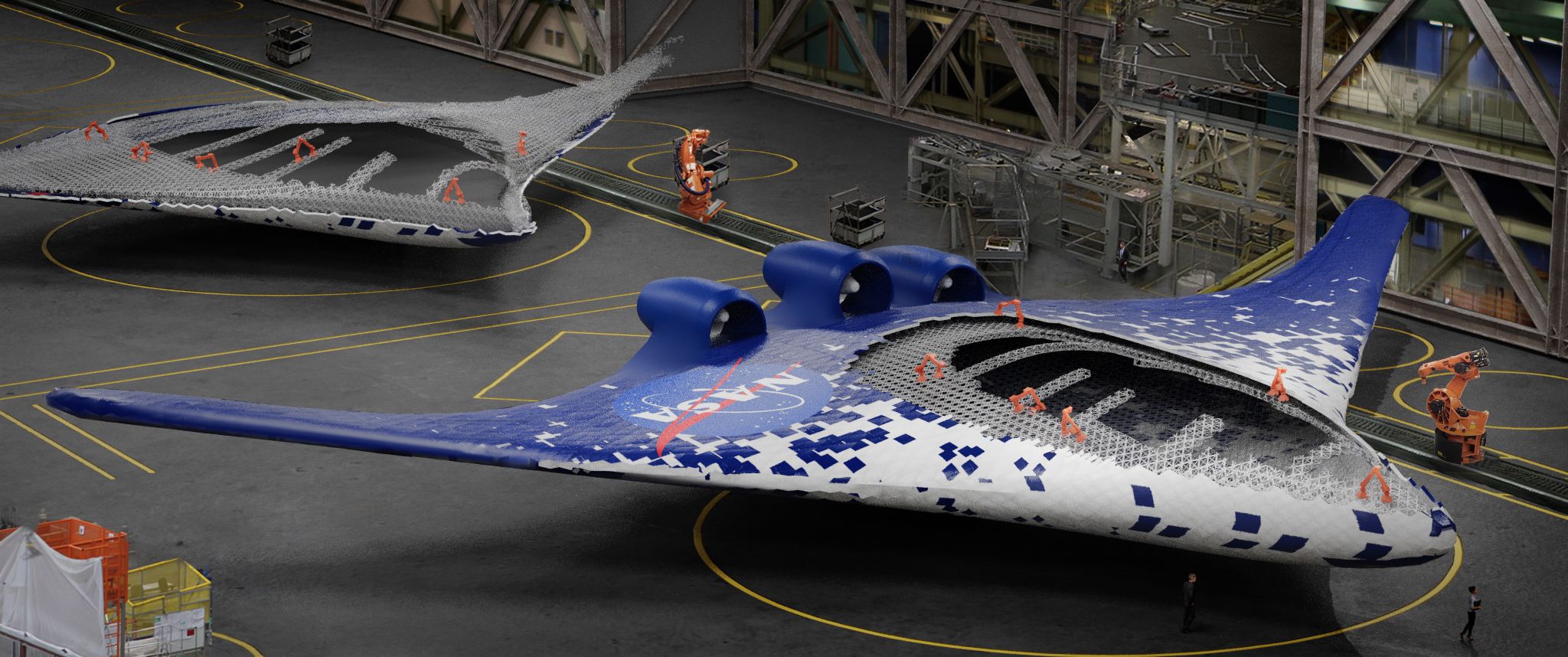
The design and testing of the robotic assembly system is the subject of an upcoming paper, Jenett says. Images for download on the MIT News office website are made available to non-commercial entities, press and the general public under a Creative Commons Attribution Non-Commercial No Derivatives license. A credit line must be used when reproducing images; if one is not provided below, credit the images to "MIT."
Mastering Lift: The Design Of Airplane Wings
The wings carry the entire weight of the aircraft, so large shear loads and bending moments are produced near the root of the wing. To this end, the wing shape typically needs to be much larger in chord and thicker in cross-section than at the wing tips to obtain the required structural strength and stiffness. The aircraft wings whose leading edges are swept forward are called swept forward wings.
US Air Force looks into blended wing body design for biggest planes - Business Insider
US Air Force looks into blended wing body design for biggest planes.
Posted: Sun, 20 Aug 2023 07:00:00 GMT [source]
Propellers can either be forward or rear-facing, and the wing form is designed to generate a channel of low-pressure air through the tube, or channel, to help generate lift. They also enable the aircraft to more easily return to wings-level flight after maneuvering when compared to straight-winged aircraft, for example. They also increase the phenomenon of the ground effect that tends to make a plane float farther before landing. Different wing planforms can typically be grouped into those used for low-speed flight, and those used for high-speed flight.
Most wings use different airfoils along their span, which can be progressively blended together to give an overall wing design that is better than could be obtained using a single airfoil. The designer can use thinner airfoils better suited to high-speed flight and transonic flow conditions toward the wing tips, where the bending moments and structural stresses are lower. Even on low-performance airplanes, there can be significant aerodynamic and performance advantages in using different airfoils at the wing root compared to the wing tip sections. However, they also have movable surfaces, such as ailerons, flaps, spoilers, trim tabs, etc., to develop additional aerodynamic forces to control the aircraft during its flight.
This is the area of the wing when viewed from directly above the aircraft. It will then be apparent that the SMC is the chord of an equivalent rectangular wing with the same area and span. The SMC is rarely used in practical aerodynamics for various reasons, including the fact that the definition of the average chord is purely geometric. Therefore, a wing with a higher span and a narrower chord will have a higher aspect ratio. Hence, the numerical value of the aspect ratio becomes a measure of the slenderness of the wing.
Aspect ratio, taper ratio, and sweepback can be mixed to create different flying experiences. A thin, long wing for instance has a high aspect ratio and therefore a better lift to drag ratio. It’s more aerodynamically efficient, generates more lift with less drag, consumes less fuel, and is ideal for sustained flight in subsonic aircraft. Longer wings are not as maneuverable as shorter wings, but they’re best at low speeds and high altitudes, and are usually more forgiving of improper pilot techniques. Most training and GA airplanes are operated at high coefficients of lift and require high aspect ratios. Many high-wing airplanes are semi-cantilevered, meaning they have external bracings or struts attached to the fuselage.
Here is shown on Baltic SeaA typical Vogt monstrosity,The One-Three-Eight by B and V. The British fighters of the day were superannuated biplanes, so the comparison cannot have been deeply gratifying to Heinkel. But Mitchell’s generous appreciation of the carefully streamlined He 70 gave legs to a story that the design of the Spitfire was “copied” or “cribbed from” or “influenced by” the Blitz. The work was supported by NASA ARMD Convergent Aeronautics Solutions Program (MADCAT Project), and the MIT Center for Bits and Atoms. While this version was hand-assembled by a team of graduate students, the repetitive process is designed to be easily accomplished by a swarm of small, simple autonomous assembly robots.
One disadvantage of this type of configuration is that because of the flow characteristics of the wings, the outboard wings stall before the flaps. Swept forward wings were therefore only used in very few aircraft, like the Grumman X-29 Switch Blade. The aircraft wings whose leading edges are swept back are called swept back wings. Swept back wings reduce drag when an aircraft is flying at transonic speeds. This is particularly so for variable geometry and combined (closed) wing types.
The upper spar cap will be loaded in compression and the lower in tension for a positive load factor (wing bending upward). The spar caps also form a boundary onto which wing skin is attached and support the wing skin against buckling. Concentrated load points such as engine mounts or landing gear are attached to the main spar.




No comments:
Post a Comment